Service Dog Tasks and the Public Access Test, Explained
This page explains the law in general terms. It is not legal advice. For a specific situation, contact the agency listed on this site or an attorney.
Two ideas sit at the center of service dog training: the task and the public access test. A task is what makes a dog a service dog. A public access test is a way to check that the dog can work calmly around other people.
This guide explains both in plain English. It shows how to build a task step by step and how to use a public access test as a training benchmark. It also covers what Kansas law says about trained and tested dogs.
What counts as a task under the ADA
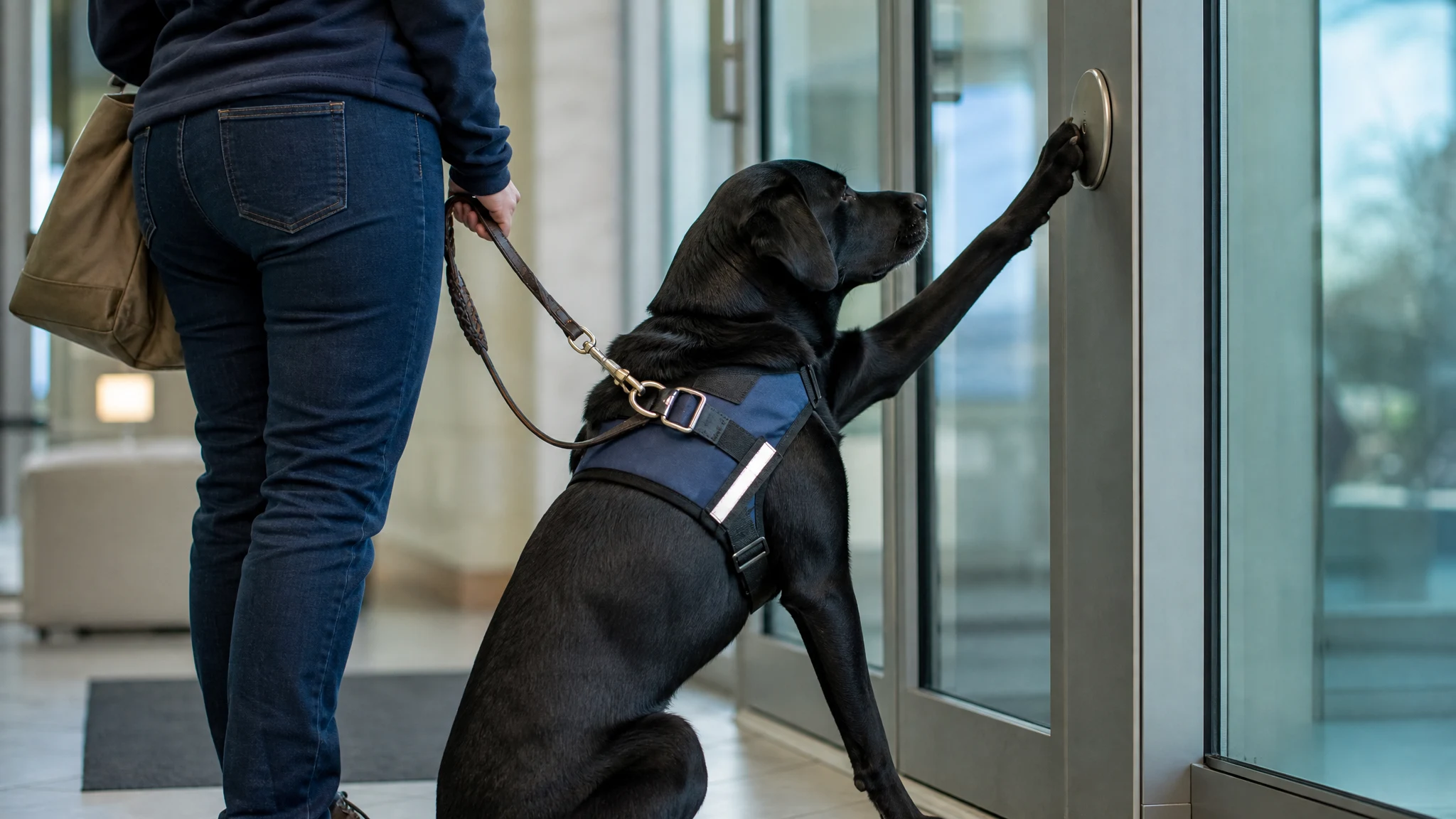
The ADA.gov Service Animals FAQ defines a service animal as a dog individually trained to do work or perform tasks for an individual with a disability. That sentence has three parts that matter: the dog is trained, the training is individual, and the dog does work or tasks for a person with a disability.
The ADA.gov FAQ also says the work or tasks must be directly related to the person's disability. A dog that does something useful in general does not qualify. The behavior has to answer a limit that comes from the handler's disability.
Examples by disability
The ADA.gov Service Animals FAQ lists examples of tasks. Here they are, grouped by disability type.
- Vision disability: guiding a person who is blind or has low vision.
- Hearing disability: alerting a person who is deaf or hard of hearing to sounds or people.
- Mobility disability: pulling a wheelchair, or retrieving dropped items.
- Seizure disorder: alerting a person to an oncoming seizure, or helping them during or after one.
- Psychiatric disability: reminding a person to take prescribed medication, or interrupting a harmful, repetitive behavior.
- PTSD: calming a person during an anxiety episode, for example by applying pressure on the body.
These are examples, not a complete list. This answers the question of what tasks a service dog can do: any trained work that is directly related to the handler's disability. The ADA.gov FAQ is the place to read the full wording.
Why comfort alone is not a task
Under the ADA, emotional support, therapy and comfort animals are not service animals. The reason is the definition itself. Being present and calming is something a pet may do on its own. A task is trained, on cue or in response to a specific sign, and tied to the disability.
The line can feel unfair to people who benefit from an emotional support animal. It is still the line the ADA draws. A dog that interrupts a panic episode on a trained cue is doing a task. A dog that is simply calming to be near is not.
Kansas law draws a similar line. The Kansas Office of Revisor of Statutes, K.S.A. 39-1113, defines an assistance dog as a guide dog, hearing assistance dog or service dog. It says a dog kept for comfort, protection or personal defense does not qualify. It also says pet-visitation therapy dogs are excluded. Kansas statutes do not recognize emotional support animals as assistance dogs.
What the public access test is, and what it is not
A public access test checks how a dog behaves in public: calm, controlled and unobtrusive around people, food, noise and other animals. Programs accredited by Assistance Dogs International (ADI) use public access testing as part of their standards. KSDS Assistance Dogs, Inc. in Washington, Kansas states that it is fully accredited by ADI. Check ADI directly for the current published standard, since this article does not reproduce it.
The test is a training benchmark. It is not a legal requirement under the ADA. The ADA.gov FAQ says a business may ask only two questions when it is not obvious what the dog does: whether the dog is a service animal required because of a disability, and what work or task the dog has been trained to perform. Staff may not require a test, a certificate or documentation.
There is no official service dog registry or required certification under the ADA. Passing a test, even a strict one, does not create legal status, and a purchased online registration is not proof of anything. The dog's legal status rests on the disability and the individual training.
What Kansas says about trained and tested dogs
Kansas law uses the word tested. The Kansas Office of Revisor of Statutes, K.S.A. 39-1108, says a person with a disability may be accompanied by a specially selected, trained and tested service dog in the public places listed in K.S.A. 39-1101. The same section covers renting and buying residential housing, with no extra charge for the dog. The handler is liable for damage the dog does.
K.S.A. 39-1111 sets a verification procedure. It uses an identification card or a letter from the training facility or, for a self-trained dog, from the dog's user. It is not a state agency registry. Kansas has no state ID program that a handler must join.
For a full picture of the state rules, programs and costs, see service dog training in Kansas: laws, programs and costs.
What you need
- A dog with a steady temperament and good health. Ask your veterinarian whether your dog is a good candidate.
- A clear written description of the disability-related need the task will meet.
- A flat buckle collar or a harness, and a standard leash.
- Small, soft treats your dog loves, plus a treat pouch.
- A clicker or a marker word such as "yes," if you like marker training.
- A notebook or phone app to log sessions.
- Access to quiet practice spaces first, then busier ones.
- Optionally, a professional trainer who uses reward-based methods.
Step by step: teach a task, then test it in public
1. Name the task and connect it to the disability
Write one sentence: "When X happens, my dog does Y, which helps me with Z." For example, "When I drop an item, my dog picks it up and puts it in my lap, which helps with limited reach." If you cannot finish the sentence, the behavior may be comfort rather than a task.
2. Break the task into small pieces
Split the task into steps your dog can learn one at a time. A retrieve, for example, becomes: look at the object, touch it, pick it up, hold it, and deliver it to hand. Teach each piece before chaining them.
3. Train with rewards
Use food, praise and play to mark and pay for the behavior you want. Humane, reward-based training is in line with the American Veterinary Society of Animal Behavior (AVSAB). Do not use shock, prong or choke collars, alpha rolls, scruffing or dominance methods. They add fear and tend to damage the working bond.
4. Add the cue or the trigger
Some tasks run on a cue you give. Others respond to a sign, such as a sound or a change in your body. Introduce the cue only after the dog does the behavior reliably, and reward when the dog responds correctly.
5. Build foundation skills in parallel
Tasks sit on top of everyday manners: a settle under a table, loose leash walking, a reliable recall, and calm around dropped food. Practice these daily in short sessions, five to ten minutes at a time.
6. Add distractions slowly
Move from your living room to the yard, then a quiet store, then busier places. Raise only one difficulty at a time: more people, more noise or more time. If your dog shows stress, step back to an easier setting.
7. Practice the public access skills
Work toward behaviors that public access tests commonly look at. Examples include walking through a crowd without pulling, ignoring other dogs, staying calm during a handler's sudden stop, and settling at a table. Ask the program or trainer you follow which skills their test uses, and check ADI for its current standard.
8. Run a mock test and score it honestly
Ask a friend to watch while you walk a route in a public place. Keep notes on what went well and what did not. Repeat in several locations, and on different days and times.
9. Know the limits for dogs in training
The ADA gives no coverage for dogs in training. Kansas is narrower than many assume. The Kansas Office of Revisor of Statutes, K.S.A. 39-1109, covers a professional trainer from a recognized training center, who may bring an assistance dog in training into the places listed in K.S.A. 39-1101 with no extra charge. As summarized, the section does not extend the right to private owner-trainers. Ask a business first before bringing a dog in training, and check with the agency if you are unsure.
10. Keep training after the test
Passing a mock test is a snapshot. Keep practicing, and retest every few months or after any change in health, routine or home.
Tips
- Train the task in the real situations where you will use it, not only at home.
- Keep sessions short and end on a success.
- Watch your dog's body language. Yawning, lip licking and turning away can mean stress.
- Give the dog real downtime. Working dogs need rest and play.
- Keep notes. They help you spot patterns and help a trainer advise you.
- Know the disability-rights basics yourself. The two-question rule on ADA.gov is worth memorizing.
Common mistakes to avoid
- Counting comfort as a task. A calm presence is welcome but is not a trained task under the ADA.
- Buying a registration or vest as proof. The ADA has no registry or required certification, and a purchase does not create legal status.
- Skipping foundation manners. A dog that can retrieve but cannot settle will struggle in public.
- Jumping to crowded places too fast. Rushing can create fear that takes months to undo.
- Using harsh tools or corrections. They run against AVSAB-aligned practice and can make behavior worse.
- Treating the test as a legal gate. It is a benchmark for you and your dog, not a requirement under the ADA.
- Misrepresenting a pet. The Kansas Office of Revisor of Statutes, K.S.A. 39-1112, makes it a class A nonperson misdemeanor to falsely claim the right to be accompanied by an assistance dog in a covered place, or to claim a disability to acquire an assistance dog.
What results to expect
Results vary with the dog, the handler, the disability and the time you can put in. Many teams find that a simple task takes weeks of steady practice, and a complex one can take months. A dog that handles a mock public access route may be better prepared for real outings, but no test can promise how a dog will act on any given day.
Expect setbacks. Young dogs, new places and busy days can all cause a dip. Going back a step is part of normal training, not a failure.
If you need help
Programs in Kansas can help with training. KSDS Assistance Dogs, Inc. in Washington is an ADI member and lists guide dogs, service dogs, facility dogs and career change dogs. Midwest Battle Buddies Inc. in Wichita serves veterans, and The Battle Within in Olathe runs a veteran and first responder program. Contact each one for current eligibility, costs and waitlists, since this article does not list them.
For a housing complaint, the Disability Rights Center of Kansas names the Kansas Human Rights Commission, or HUD, as places to file. Check with the agency directly for current contact details. This article explains the law and is not legal advice.
Sources
- ADA.gov Service Animals FAQ
- Kansas Office of Revisor of Statutes, K.S.A. 39-1113
- Kansas Office of Revisor of Statutes, K.S.A. 39-1108
- Kansas Office of Revisor of Statutes, K.S.A. 39-1109
- Kansas Office of Revisor of Statutes, K.S.A. 39-1111
- Kansas Office of Revisor of Statutes, K.S.A. 39-1112
- KSDS Assistance Dogs, Inc.
- Midwest Battle Buddies Inc.
- The Battle Within - Dogs 4 Valor
- Disability Rights Center of Kansas, Disability Rights in Fair Housing